Feature
Cited answers you can verify in context
A practical workflow for importing supported sources, asking a question, opening the cited passage and checking whether the source still supports the answer.
Why it matters
Krynia starts with a source boundary, not an open-ended company search. Add one public GitHub repository or upload a bounded set of Markdown, text or CSV files that your workspace is allowed to use. Wait until the source is ready; the last successful index remains available while a replacement is prepared.
Illustrative question (only when the current source scope supports it): “What is our refund exception policy?” This is a useful test when that policy exists in the published material you imported. The workflow is designed to check that source, not treat product copy alone as confirmation.
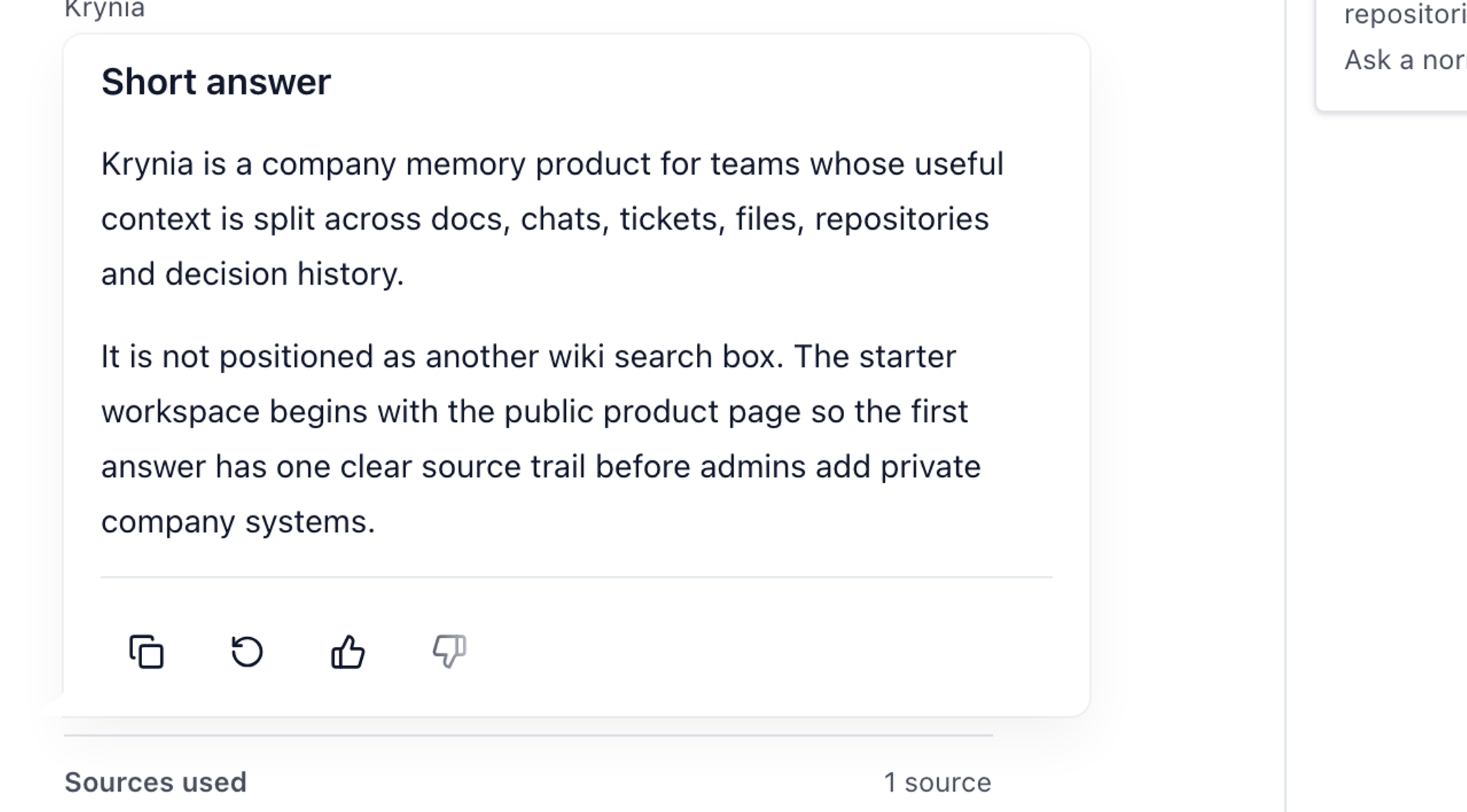
Ask in your own words. Krynia searches the indexed material and returns a concise answer with citations to the passages it used. If the supplied sources do not establish the answer, the useful result is an evidence gap: Krynia should not fill it with a plausible policy or outside knowledge.
Open the cited passage and read the surrounding context. A citation tells you where the evidence was found; it is not a guarantee that the statement is true, approved or still current. Check the document title, section, version or indexed commit before using the answer in a decision.
Then check for an update. A public GitHub citation opens the file at the commit Krynia indexed. If the published document has changed since that commit, refresh the source and ask again. The old citation remains useful as a record of what supported the earlier answer, not as proof of today's policy.
Finally, judge authority and conflicts yourself. An approved policy may carry more weight than a draft, while a newer release note may explain a change. Krynia can show the competing passages and their source context; it cannot decide which document your company treats as authoritative.
When the evidence is insufficient, follow the source rather than the summary: publish the missing explanation in a supported document, update the source and let it index before relying on a new answer. Notes that exist only in an unsupported system are outside this workflow until someone records the stable decision in an imported source.
Import the published source before asking about a policy or exception.
Treat the citation as an evidence location, then inspect its context and version.
Compare source authority and dates when passages disagree.
Keep the answer inside the supplied source scope, including when that means saying that evidence is missing.
Related pages
Related pages
Keep moving through the adjacent evaluation questions.
Feature
Know exactly what Krynia can search
The current source boundary: one public GitHub repository or a bounded set of Markdown, MDX, text and CSV files.
Open pageFeature
Company memory pricing without seat tax
Why pricing by retained indexed knowledge can fit company memory better than charging for every employee who needs to search or verify an answer.
Open page