Answers from repository documentation

Ask the question. Open the source behind the answer.

The useful detail may be in a repository while the page in Confluence is already out of date. Krynia indexes the material you add, answers questions about it and links back to the source.
Krynia workspace preview

Ask Krynia
What is Andocs and which sources explain the product?

Andocs manages templates, approvals and signing.
Krynia cites the product docs first.

Access checks before answersConnected company memory
One public GitHub repository Markdown, MDX, text and CSV Answers with source links No charge per teammate Runs on Cloudflare infrastructure

The problem

The answer exists. Finding it is the slow part.

A wiki search can return a long page without the detail you need. The current explanation may be in a repository, while the page everyone knows has not been updated.

The useful detail is in the repository

The product description may be in Confluence, while the current behavior or exception is already documented in a README or another Markdown file.

Documentation falls behind the work

The familiar page stays the first place people search even after the useful explanation has been updated somewhere else.

Search returns a page, not the answer

Even the right long document still has to be read. What you need is a short result and a source link you can check.

Chat-first company memory

Answers stay tied to source context.

Krynia keeps chat simple for the team while admins can review the material used, the relationship map, the connected sources and monthly knowledge usage behind every answer.

Source summaries keep answers concise without exposing raw internal documents.

Admins can review sources and graph links before trusting or correcting an answer.

Pricing stays tied to retained indexed knowledge, not seats.
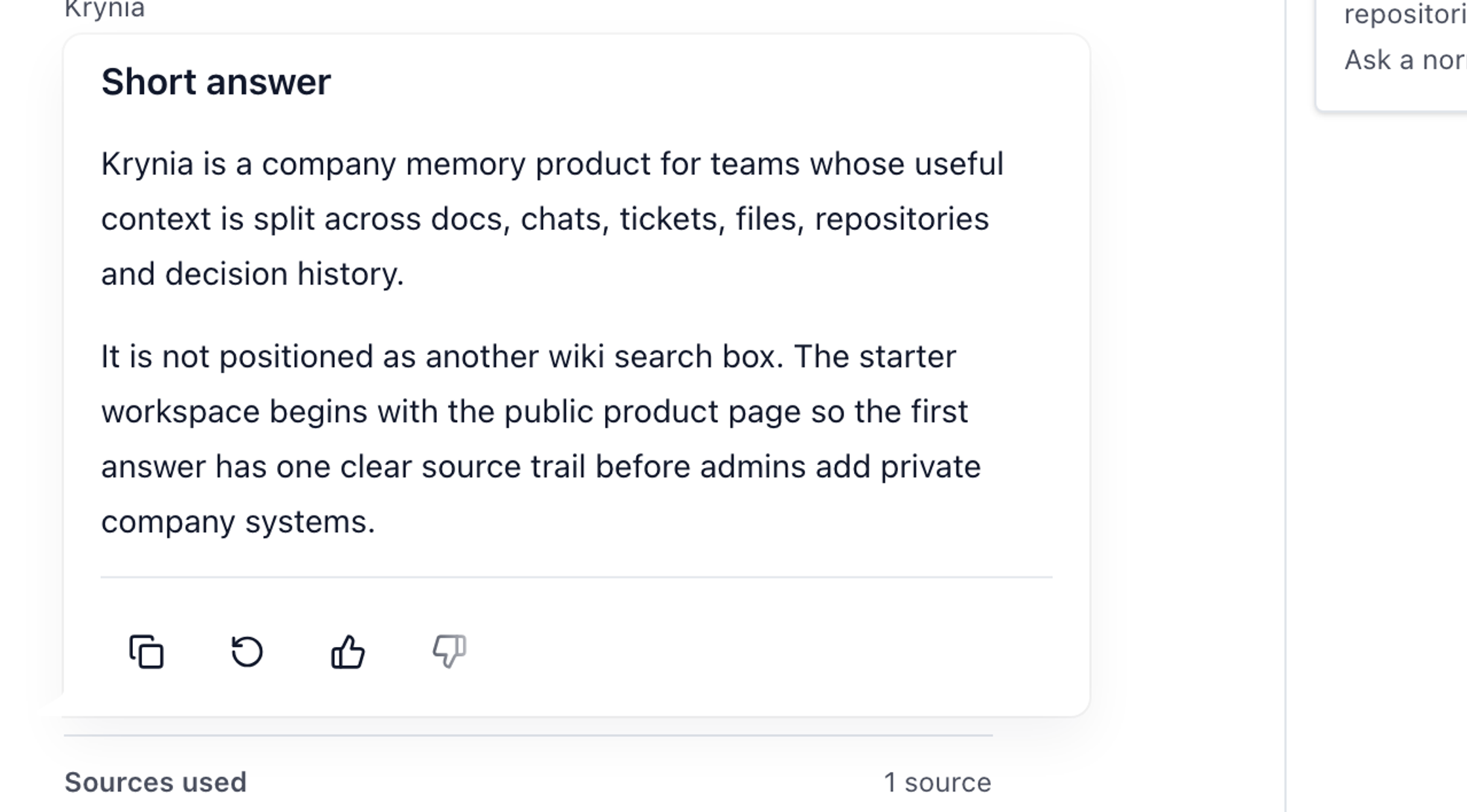
Krynia workspace showing a cited answer with sources and answer context.
Cited answer in contextShort answer, sources ready to review.
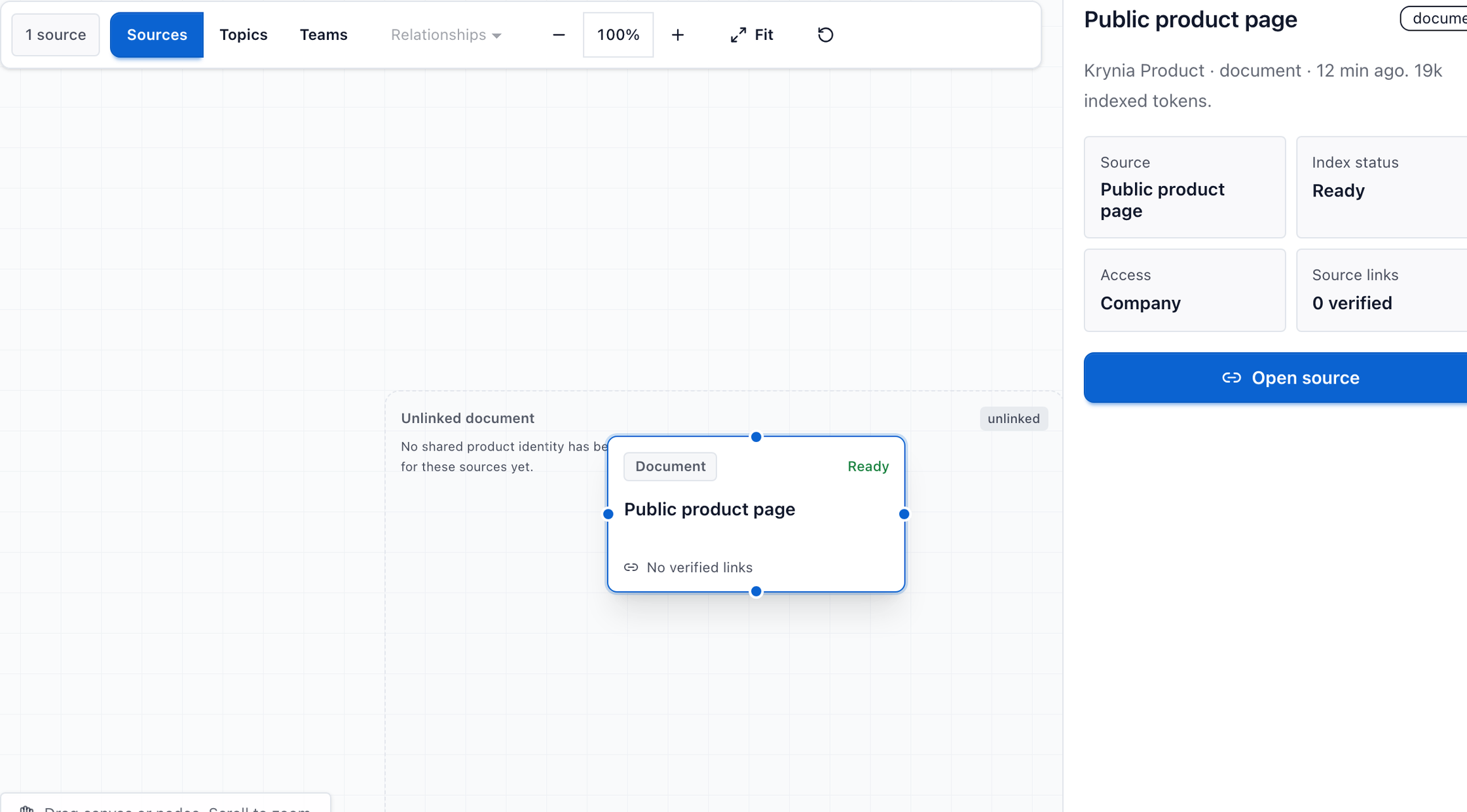
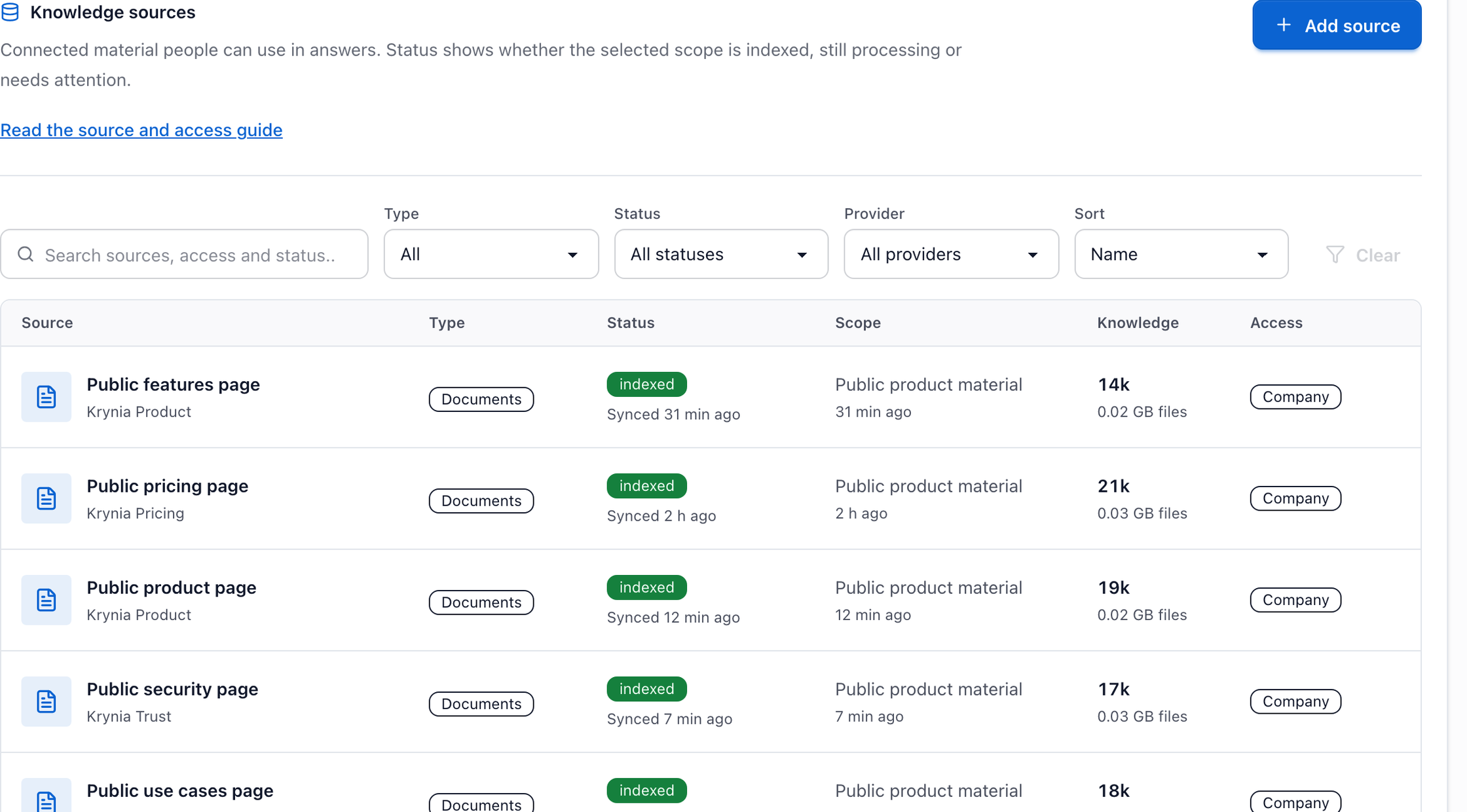
Krynia knowledge base screen with connected sources, access scope and sync status.
Source readinessSearchable, indexing and restricted sources.
Krynia knowledge graph screen with related source nodes and a selected item panel.
Knowledge mapTopics, source links and access-aware relationships.

Chat-first company memory

Cited answer in context

Short answer, sources ready to review.

Krynia workspace showing a cited answer with sources and answer context.
Cited answer in contextShort answer, sources ready to review.

Product

One question over the material you added.

Krynia currently works with one public GitHub repository and bounded Markdown, text or CSV uploads. It returns an answer with citations instead of asking you to scan every matching file.

Ask instead of scanning every file

Write the question in your own words. Krynia searches the indexed material and returns a short answer.

Open the exact GitHub version

Repository citations point to the file at the commit Krynia indexed, so a later edit does not change the evidence behind an old answer.

Upload a small set of documents

Add bounded Markdown, text or simple CSV files when the useful material is not in the connected repository.

Keep the previous index during refresh

A new indexing run is prepared separately. The last successful version stays searchable until the replacement is ready.

Who it fits

For teams with knowledge spread everywhere.

Small teams that keep product or project documentation in a public GitHub repository.

People who know the answer is in a long Markdown document but do not know the page or wording.

Teams that want to verify each answer before adding more sources and colleagues.

Use cases

Chat is the main UI, but every answer stays tied to sources.

Product, support, engineering and onboarding teams can ask normal questions and still get answers they can verify.

Product and support

Find product context

"What is this product and where is the source?"

Short answer with citations to docs, repositories and decisions.

Engineering

Trace dependencies

"What depends on this service, package or feature?"

Evidence from repositories, tickets, docs and graph links.

People and team leads

Onboard new people

"What should a new teammate read first?"

A scoped reading path based on real company sources.

Founders and managers

Recover decisions

"When did we decide this and why?"

Timeline-style answer grounded in PRs, issues, docs and chats.

Workspace admins

Admin visibility

"What are people searching for and what is missing?"

Topic groups, failed searches, source gaps and traceable citations.

Everyone

Meeting prep

"What context do I need before this discussion?"

KB-first briefing now; calendar-aware preparation can follow later.

Workflow

Add the material, let it index, then ask.

The first setup is deliberately narrow. You can see when a source is queued, indexing, ready or needs attention before anyone relies on its answers.

01

Add the first source

Connect one public GitHub repository, or upload Markdown, text or CSV documents from the workspace.

02

Wait for indexing

Krynia reads the supported files and prepares them for search. A larger source can take a few minutes.

03

Ask the question

Search in your own words instead of guessing the title or exact phrase used in the document.

04

Open the citation and invite colleagues

Check the source behind the answer. When the workspace is useful, invite colleagues by their verified email address.

Integrations

What you can add today

Connect one public GitHub repository, or upload bounded Markdown, text and CSV files. GitLab, Google Drive, Slack, Confluence and private repositories are planned, not available today.

Available connector

1

Indexed data in this preview

0

GitHub repositories

manual initial indexing

available

Public repository Markdown and text documents for the first production connector.

Scope: one public repository

GitLab projects

not available

next

Planned connector for repository documents and project context.

Scope: planned

Google Drive

not available

next

Planned connector for selected documents and shared drives.

Scope: planned

Slack channels

not available

next

Planned connector for selected channel context.

Scope: planned

Admin controls

See what is indexed and what needs attention.

The source list shows the current indexing state, the last successful version and failures that need action. Removing a source also removes its indexed material.

Krynia's managed AI route is used only to prepare answers. Customer prompts, cited source context, embeddings and answers are not used to train AI models.

Confluence search works when the right page exists, is current and uses the words you searched for.

Krynia is useful when the answer is inside the repository documentation you added and you want the supporting source, not another file list.

Workspace health

Access, answer controls and knowledge usage in one place.

Passwordless access

Google, Microsoft, passkeys and domain-based workspace join.

Workspace membership

Verified workspace members can search the sources available in that workspace.

Managed AI route

Default answer path, training policy and future external routes stay admin-visible.

Clear pricing

10-page policy: included in EUR 47 base.

Pricing

Pricing people can understand before they connect a single source.

Krynia bills the knowledge still kept at billing close. Regular sync, storage, citations and normal chat are already part of the base product.

Meter

€0.47

per 1M indexed tokens

Minimum

€47.00

product plus 5M indexed tokens

Included

5M

about 7.7k A4 pages

Why the minimum is EUR 47

The monthly base includes product access, sync, citations and the first 5M indexed tokens. Overage starts only after that included volume.

No seat-based tax for quiet users.

Deleted or stale chunks removed before billing close do not count.

Open pricing calculator